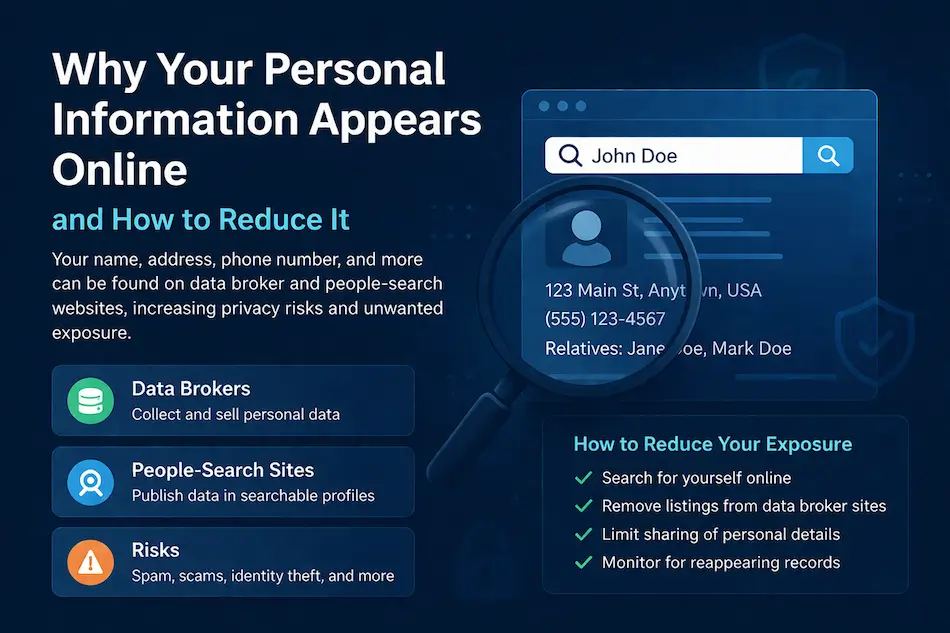
Personal information often appears online through data brokers and people-search websites, increasing privacy risks and unwanted exposure.
Most people do not realize how much personal information is available about them online until they search for themselves and see it firsthand. Names, addresses, phone numbers, and other details can appear across multiple websites, often without clear consent or awareness. Understanding how that information gets there is the first step toward reducing your exposure and taking back more control over your privacy.
Understanding where your data goes and
what you can do about it
Many people are surprised when they search for themselves online and find far more personal information than they expected. A quick search can reveal names, phone numbers, home addresses, age ranges, relatives, and other details gathered into a public-facing profile. In some cases, that information appears on multiple websites at once.
This happens because personal data moves through a large network of data brokers, people-search websites, public records, and commercial databases. Much of it gets collected, packaged, and published without people realizing how widely it has spread. What feels private in everyday life can become easy to find online.
That exposure can create real problems. It can lead to spam calls, scam attempts, phishing messages, identity theft risks, and unwanted attention. It can also make people feel like they have lost control over their own privacy.
The good news is that there are ways to reduce that exposure. It may take time and effort, but understanding why your information appears online is the first step toward limiting it. Once you know where the problem starts, it becomes easier to take action.
What personal information can appear online
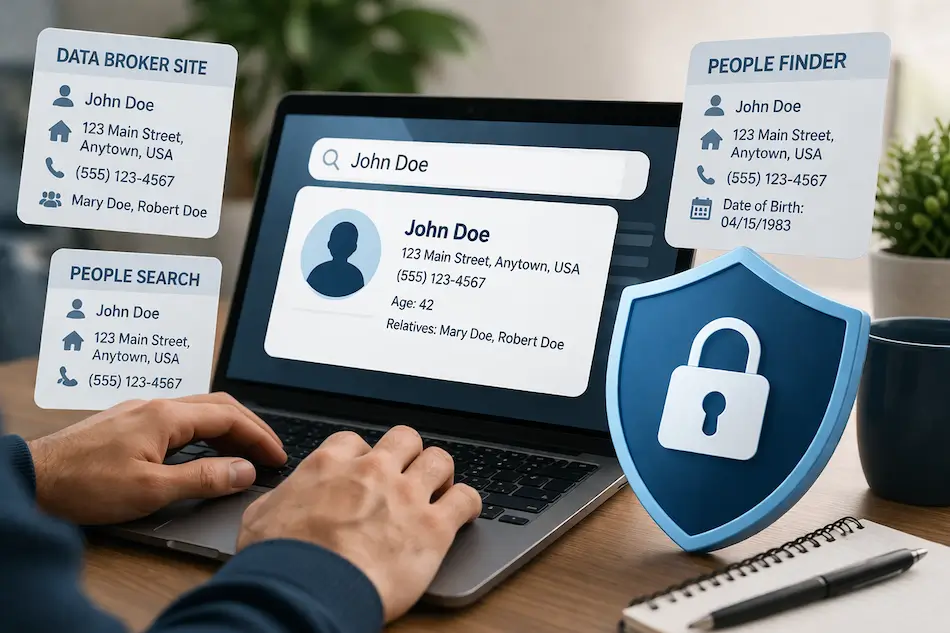
Many websites publish more than just a name. A typical online profile may include current and previous addresses, phone numbers, email addresses, age ranges, relatives, aliases, and other identifying details. Some sites may also show property information, location history, or public-record details that help build a broader picture of a person’s life.
On their own, these details may seem minor. However, when websites combine them into a single searchable record, they become far more revealing. A name linked to a home address and phone number creates a very different level of exposure than any one detail by itself.
This is one reason people often feel uneasy when they discover these listings. The issue is not just that a piece of information exists somewhere online. The issue is that multiple pieces of information can be grouped, displayed, and accessed in seconds by anyone who looks for them.
Why your information ends up online
Personal information appears online because many companies collect data from a wide range of sources, then organize and redistribute it. These sources may include public records, property filings, marketing databases, survey responses, online account activity, and other third-party sources. Once collected, that information may be shared, sold, licensed, or published across multiple platforms.
In many cases, people never directly gave their information to the website where it appears. Instead, their data may have passed through several companies before reaching a public listing. That is why online exposure can feel so frustrating. A person may have no relationship with the site showing their information, yet their details still appear there.
The process often works quietly in the background. Information gets copied, refreshed, and redistributed over time. As a result, one record can spread to many sites, and similar versions of the same profile may stay online for months or years unless someone actively tries to remove them.
What data brokers actually do
Data brokers are companies that collect personal information, organize it into profiles, and make it available for marketing, business, or other commercial purposes. Some specialize in consumer data. Others focus on demographic information, location details, contact records, or public-record aggregation.
These companies often pull data from many different channels. Public records may provide address history or property details. Commercial data sources may add phone numbers, email addresses, or household information. Other inputs can help connect these details into larger profiles.
Some brokers sell or license their data to other businesses. Others make it available through searchable websites. Either way, the result is the same for the individual: more personal information becomes easier to find, compare, and reuse.
Many people do not know the term "data broker" until they encounter a privacy problem. Yet these companies play a major role in explaining why personal information spreads so widely online.
How people-search websites make data easy to find
While data brokers collect and package information, people-search websites make that information easy to access. These sites often let users search by name, city, phone number, or address. In just a few seconds, someone may pull up a profile that combines multiple pieces of personal data in one place.
This makes the privacy issue more visible. A record that once existed across separate public sources can become a single, easy-to-read listing. That convenience is part of what makes these sites concerning. They lower the effort required to find detailed information about someone else.
People-search sites also amplify exposure by creating the impression that the information is complete and verified, even when some details are outdated or incorrect. A listing may include old addresses, former phone numbers, or mixed records that still create privacy concerns despite inaccuracies.
For the person being listed, the problem remains the same. Whether the information is new, old, accurate, or partially wrong, it still makes private life more public than many people want.
Why online exposure creates real risks
When personal information becomes easy to find, it can create more than annoyance. It can increase the chance of spam, robocalls, phishing attacks, identity theft, harassment, stalking, and doxxing. Public exposure also gives bad actors more information to use in convincing messages, false claims, and targeted scams.
For example, someone who knows a person’s name, phone number, city, and relatives may have an easier time creating a message that sounds legitimate. That can make scam attempts harder to spot. A fraudster does not always need highly sensitive information at the start. Sometimes a collection of ordinary details is enough to build trust and continue the attack.
Online exposure can also become a personal safety concern. When home addresses, family details, or household information are easy to locate, the risk goes beyond marketing and unwanted contact. Privacy is not just about convenience. It is also about control and security.
Even when the worst-case outcome never happens, many people still feel uncomfortable knowing that strangers can look them up so easily. That feeling alone is enough reason to take the issue seriously.
Why spam, scams, and robocalls often get worse
One of the most common effects of online data exposure is an increase in unwanted contact. Phone numbers, email addresses, and mailing addresses can circulate through marketing lists, lead-generation databases, and broker networks. Once that happens, people may see more spam calls, promotional outreach, suspicious texts, and scam emails.
Some of this activity may be legal marketing. Some may be misleading or fraudulent. Either way, the result is often the same: more interruptions, less trust, and more time spent deciding which messages are real.
The problem grows when contact information appears on multiple sites at once. That wider exposure can make it easier for more businesses and bad actors to access the same details. Removing those listings may not stop every spam message, but it can help reduce how easily that information continues to spread.
Why identity theft often starts with small details
Many people think identity theft begins only when a criminal gets highly sensitive data. In reality, fraud often starts with smaller pieces of personal information that help build a profile over time. Name, address, age range, phone number, and family connections can all support social engineering, account targeting, and impersonation attempts.
Bad actors often work in steps. They gather basic data first, then use it to uncover more. A person who already knows where you live, who your relatives are, or what phone number belongs to you may have an easier time making fraudulent contact look convincing.
This is why reducing publicly available information matters. Less exposed data means fewer building blocks for fraud. No single step eliminates all risk, but limiting what is easy to find can make targeting much harder.
Why manual removal takes so much effort
Many people assume they can remove their information simply by contacting a website once. In practice, the process is usually more complicated. Each site may have its own opt-out system, search rules, form requirements, verification steps, and review timeline. There is no universal removal process across all sites.
One website may ask for a copied link to a record. Another may require email confirmation. A third may ask for identity verification before processing the request. Some removals happen quickly, while others take longer or require follow-up.
This makes manual privacy cleanup slow and repetitive. A person may need to search site after site, locate the correct record, complete separate requests, and keep track of what has already been submitted. That workload adds up fast, especially when information appears across many platforms.
For people with busy schedules, the task often becomes something they mean to do later but never fully finish.
Why personal information can come back after removal
Removing a record once does not always mean it stays gone. Data broker databases often refresh over time. New records may appear. Older information may be republished. Similar listings may show up on related sites that use overlapping sources. Privacy management is often ongoing, not one-and-done.
This is one of the most frustrating parts of the process. Someone may spend time submitting removals, only to discover months later that the same information has returned in a slightly different form. That does not always mean the original effort failed. It often means the larger data ecosystem continues to circulate the same details.
Ongoing monitoring matters because the problem itself keeps moving. New exposures can appear even after earlier ones are removed.
What you can do to reduce your online exposure
While removing personal data completely may not be realistic, people can still take meaningful steps to reduce how easy it is to find. The first step is simple: search for yourself online. Look up your name, phone number, and address to see which types of listings appear.
From there, you can review the results and identify the sites that publish your information. Many broker and people-search sites offer opt-out processes, even if they are not always quick or easy to use. Submitting those requests can help reduce visible exposure over time.
You can also make it harder for new information to spread by limiting what you share publicly. Review privacy settings on social platforms. Avoid posting contact details in open forums. Be selective about where you submit forms that request personal information.
It also helps to keep watching for new listings. Privacy protection works best as a habit, not a one-time task. Even small actions, repeated consistently, can make a difference.
How ongoing monitoring supports better privacy
Monitoring matters because online data exposure changes over time. A listing that disappears today may return later. A site that never showed your information before may add it in the future. New broker networks and search tools also continue to emerge.
This means privacy protection is not only about removal. It is also about visibility. People need a way to know when their information appears again so they can respond. Without monitoring, it is easy for exposure to return unnoticed.
For some people, periodic self-checks may be enough. Others may prefer a more structured way to keep track of these changes. The right approach depends on how much time a person wants to invest and how actively they want to manage their online footprint.
When a privacy service may make sense
Some people choose to handle removals manually. Others decide the process is too time-consuming and want a simpler option. A privacy service can help when someone wants to reduce exposure but does not want to manage dozens of separate opt-out requests alone.
These services generally help by scanning data broker and people-search websites, identifying exposed records, submitting removal requests, tracking progress, and monitoring for reappearing information. That can save time and reduce the burden of managing everything site by site.
This kind of support can be especially useful for people dealing with repeated spam, privacy concerns, or personal safety issues. It can also help anyone who values privacy but knows they are unlikely to keep up with manual removals over the long term.
How RemoveMe can help reduce that burden

For people who want a more streamlined approach, RemoveMe is one option to consider. It is a cloud-based service that users access through a browser, so there is no software to download and no license key to manage. After purchasing the service, the user receives an email with a link, sets login credentials, and signs in to a dashboard that shows the status of their account.
RemoveMe is designed to find and remove personal information from more than 115 data broker and people-search websites, then continue monitoring for re-exposure over time. It helps automate the process of locating records, submitting removals, and tracking progress in one place.
The dashboard gives users a clearer view of what is happening. It can show which sites were scanned, how many exposures were found, which requests are in progress, and which removals have been completed. Notifications can also help users stay aware of new exposures and updates.
For people who do not want to handle privacy cleanup manually, a service like RemoveMe can make the process more manageable. Rather than replacing privacy awareness, it supports it with tools and ongoing monitoring.
👉 Learn more about iolo RemoveMe service
A more realistic path to better privacy
Personal information appears online for many reasons, and most of them happen outside a person’s direct control. Data brokers collect it. People-search sites publish it. Commercial systems redistribute it. That is why the problem can feel so widespread and so difficult to solve.
Even so, reducing online exposure is possible. It starts with understanding how the system works and recognizing the risks that come with public-facing personal data. From there, people can take steps to remove listings, limit future exposure, and monitor for records that return.
Better privacy usually does not come from one big fix. It comes from a steady effort to reduce what others can easily find. For some people, that means handling removals themselves. For others, it may mean using a service such as RemoveMe to simplify the work and support ongoing protection.
Either way, the most important step is to treat online privacy as something worth managing. The more control you take over your digital footprint, the harder it becomes for others to use your information in ways you never intended.